Mathematical Foundations Linking Advantage Play in Cards, Dice, and Sports Markets
Carlo Werner · Oct 26, 2026

Mathematical Foundations Linking Advantage Play in Cards, Dice, and Sports Markets
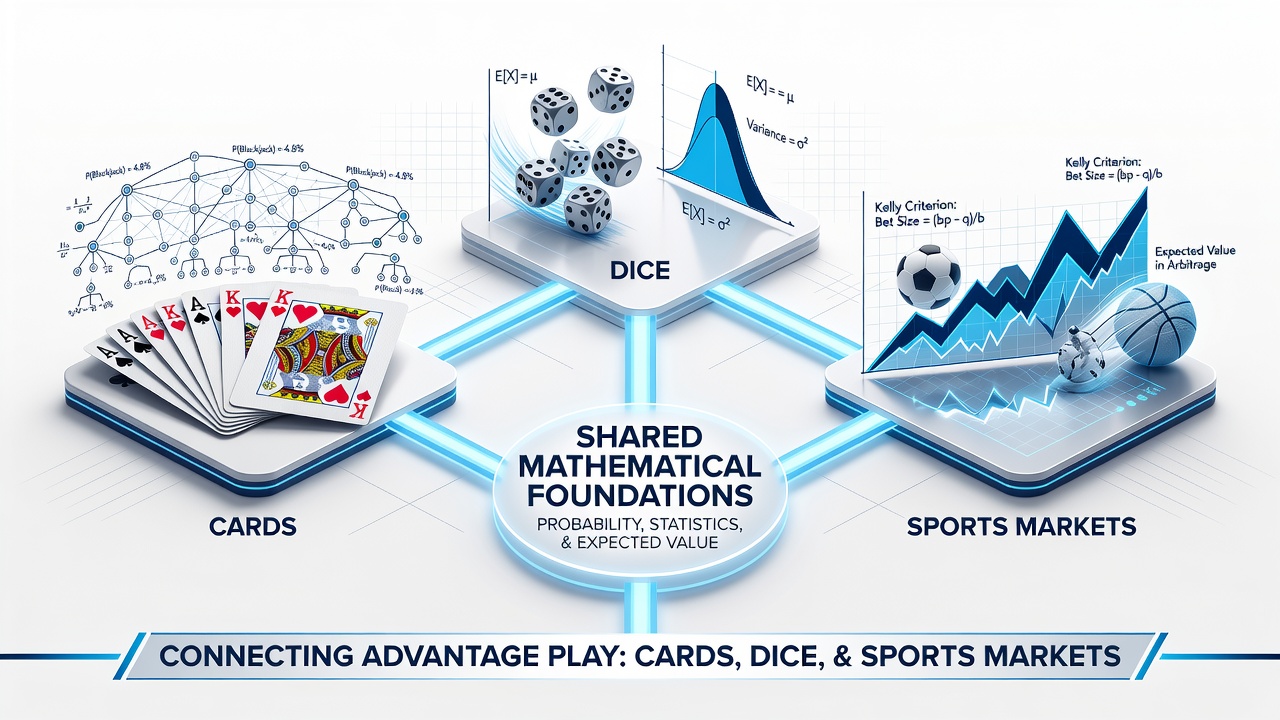
Advantage play across different formats draws from identical mathematical structures that allow participants to identify and exploit edges, and researchers have documented these overlaps in probability calculations, expected value formulas, and variance management techniques for decades.
Core Probability Structures in Card Games
Card games such as blackjack rely on conditional probability updates that shift with each revealed card, and players apply combinatorial analysis to track remaining deck compositions while adjusting bet sizes accordingly. Studies from institutions like the University of Nevada Reno show how counting systems convert raw probabilities into actionable edges that range between 0.5 and 2 percent under optimal conditions, and these same counting principles extend directly into dice scenarios where independent outcomes receive updated assessments based on observed sequences.
Shared Expected Value Calculations
Expected value serves as the unifying metric that quantifies long-term profitability across cards, dice, and sports markets, and observers note that the formula EV equals probability of win multiplied by payout minus probability of loss multiplied by stake remains identical whether applied to a blackjack hand, a craps proposition bet, or a sports wager on point spreads. Data from the Nevada Gaming Control Board indicates that games with positive EV opportunities appear consistently when players incorporate real-time information updates, while sports betting markets display comparable dynamics once line movement and injury data receive integration into pricing models.
Variance and Bankroll Management Techniques
Variance measures the dispersion around expected returns, and participants in all three domains apply the same standard deviation formulas to determine required bankroll sizes that withstand downswings without ruin. Those who've examined professional records discover that a bankroll covering 50 to 100 standard deviations of expected loss maintains viability across extended sessions, whether the activity involves tracking cards through multiple decks, monitoring dice outcomes for bias detection, or modeling sports results with Poisson distributions for score predictions.
Statistical Modeling in Sports Markets
Sports betting incorporates regression analysis and Monte Carlo simulations that mirror the simulation techniques used to test card counting systems or dice bias hypotheses, and analysts frequently reference academic papers from institutions such as the University of Alberta that demonstrate how Bayesian updating refines probability estimates in real time. These methods allow edge identification when public odds lag behind calculated true probabilities, creating opportunities parallel to those found when card removal alters remaining deck odds or when physical dice show measurable deviations from uniform distribution.
Information Asymmetry and Edge Extraction
Advantage players across formats capitalize on information asymmetry, and the mathematical process of converting imperfect data into refined probability estimates follows identical Bayesian frameworks regardless of whether the source involves hidden cards, physical dice characteristics, or unreported team injuries. Reports compiled by the Australian Gambling Research Centre highlight how successful operators in each category maintain detailed logs that feed into iterative model improvements, and the resulting edge calculations rely on the same covariance matrices to account for correlated risks that appear in multi-hand sessions, simultaneous dice bets, or parlays across multiple sports events.
Conclusion
The mathematical foundations connecting advantage play remain consistent because probability theory, expected value, and statistical inference operate independently of the specific game mechanics involved, and practitioners who master these shared tools can transfer analytical approaches between cards, dice, and sports markets without fundamental retraining.